Major Update to Fitrockr Survey Module
Nov 29, 2026
Fitrockr Expands Its Surveys Module with Powerful New Features
Fitrockr is rolling out a major update to its Surveys module, giving research teams, clinicians, coaches, and wellness program managers more control over how they design, deliver, and analyze survey data alongside biometric and activity data collected from wearables. The update introduces new question types, more flexible respondent experiences, easier data management, and smarter delivery scheduling. Here’s a look at what’s new.
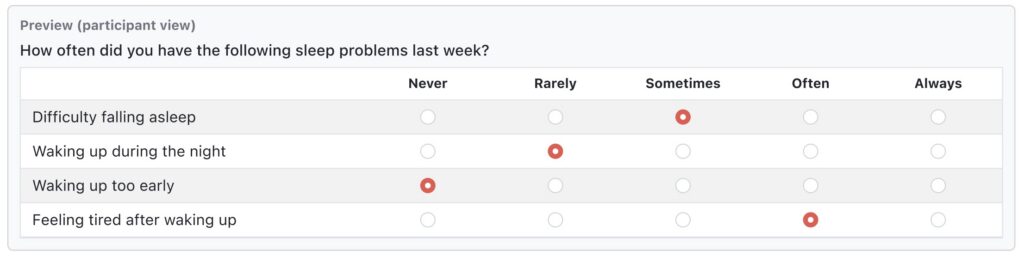
Matrix Questions
Surveys often need to ask the same set of response options across multiple related items — think symptom frequency, satisfaction ratings, or Likert-style agreement scales. The new matrix question type lets survey designers present these as a single, compact grid instead of repeating the same question structure over and over.
This makes long survey instruments, such as validated clinical questionnaires or multi-item outcome assessments, faster to build and faster for participants to complete, while keeping the underlying data cleanly structured for analysis.
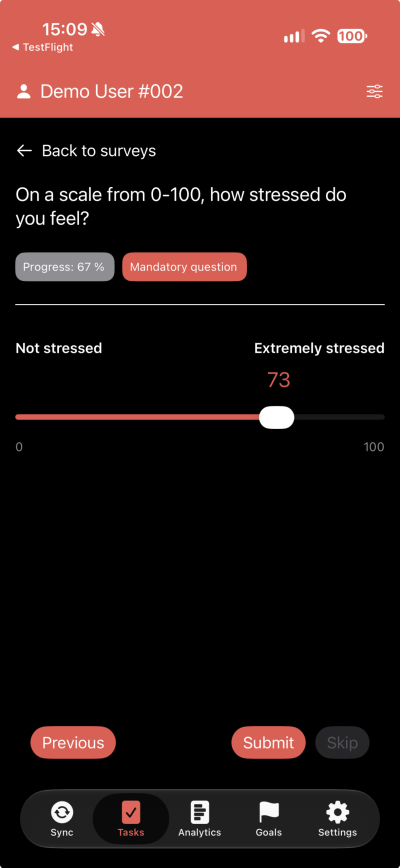
Slider Questions
Surveys can now include slider-based response inputs, giving participants an intuitive, touch-friendly way to indicate a value along a continuous scale — for example rating pain, mood, energy, or perceived exertion. Sliders offer a more granular and natural response format than traditional radio buttons for these kinds of subjective ratings, which can be especially valuable in research and clinical contexts where fine-grained self-report data matters.
Flexible Progress Indicators
Survey administrators can now choose how respondents see their progress through a survey. Progress can be shown as a simple percentage complete, or as a question counter in the format “Question X of Y.” This gives study teams the flexibility to match the progress indicator to the tone and length of their survey — a percentage for shorter, consumer-facing surveys, or a question count for longer clinical and research instruments where participants benefit from a clear sense of how many questions remain.
Custom Question Codes
Every question in a survey can now be assigned a self-defined question code. Rather than relying on default, auto-generated identifiers, researchers and administrators can label questions with their own naming conventions — for example aligning codes with an existing study protocol, questionnaire scoring key, or internal data dictionary. This makes it significantly easier to identify, reference, and map individual questions when reviewing results or exporting data for analysis.
Horizontal Export View for Survey Responses
Survey response exports previously displayed answers in a list view only. Fitrockr now also offers a horizontal display option for exported responses, laying out each respondent’s answers across a row with one column per question. This format is often easier to work with in spreadsheet tools and statistical software, particularly for teams doing cross-respondent comparisons or feeding survey data directly into further analysis pipelines.
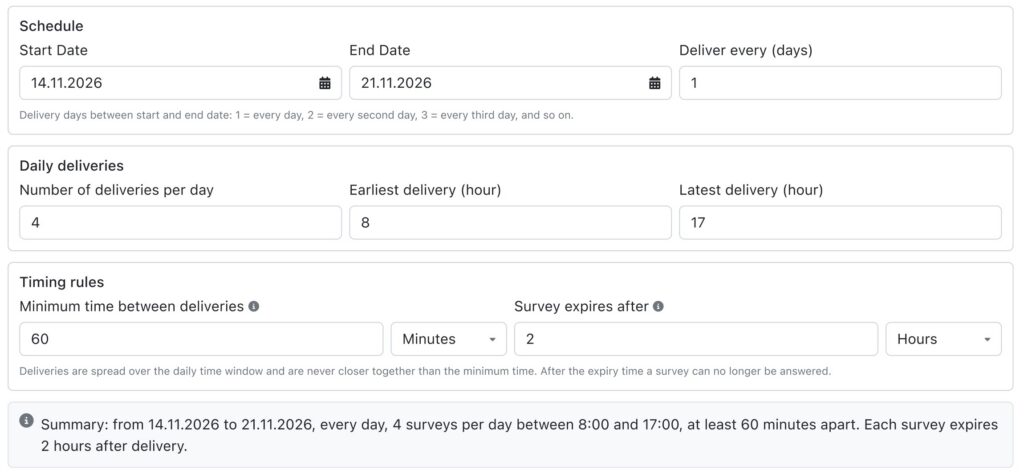
Randomized Survey Scheduling and Delivery
To reduce predictability effects and support more rigorous study designs, surveys can now be scheduled and delivered to participants at randomized times. Rather than sending a survey at the same fixed time every day or period, Fitrockr can vary delivery within defined windows — particularly useful for experience-sampling methods, ecological momentary assessment designs, and studies aiming to minimize anticipatory or habituation effects in participant responses.
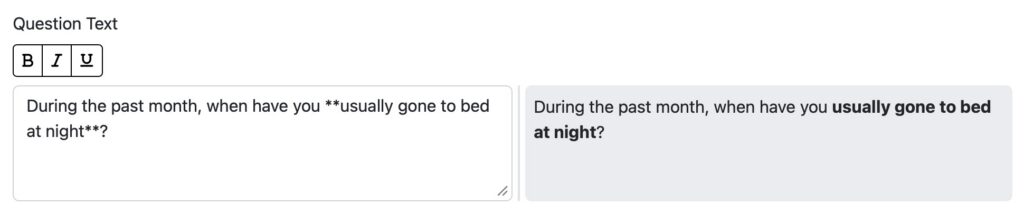
Rich Text Formatting for Questions
Question text can now be formatted with bold, italic, and underline styling. This allows survey authors to emphasize key terms, clarify instructions, or highlight important context directly within a question — improving readability and helping ensure participants understand exactly what’s being asked, especially in longer or more technical questions.
Availability
These Surveys module enhancements will be made available to all Fitrockr customers building surveys, questionnaires, and outcome assessments on the platform in the upcoming weeks. Together, they make it easier to design more sophisticated survey instruments, deliver them in ways that reduce bias, and work with the resulting data more efficiently — all while staying within Fitrockr’s existing framework for data privacy and security.