
-
Getting Started
-
Wearable
- Garmin Device Firmware Guide
- Check Garmin Device Firmware
- Set up and Connect Garmin Index2 Scale
- Screen Control on Garmin Wearables
- How to charge Garmin devices best
- Wearable and Device ID Management
- Setup: Prepare Wearable Devices
- Compatible Garmin Devices
- Garmin Timezone & Time
- Wifi Capabilities and Restrictions of Garmin Devices
- Screenless bands for blinded data collection
-
Setup
-
Manage
-
Data Collection
- Collect Data: Synchronization Types
- Collect Data: Tablet Sync (multi-sync) with "Fitrockr Hub (Multi-Sync)" app
- Collect Data: Smartphone Sync (single-sync) with Garmin Connect app
- Collect Data: Overview
- Collect Data: Smartphone Sync (single-sync) with Fitrockr app
- Collect Data: Sync via USB cable to Laptop
- Collect Data: Smartphone Sync (single-sync) with Omron Blood Pressure Monitors
- Apple Health and Google Health Connect
- Withings
- Wifi Capabilities and Restrictions of Garmin Devices
- Wearable Sync Methods and Frequencies
- Samsung Health
- Oura
- Polar
- Collect Data: Menstrual Cycle Tracking
- Screenless bands for blinded data collection
- Show all articles (1) Collapse Articles
-
Track
-
Analyze
- Analyze: Overview
- Analyze: Data Export
- Analyze: Standard Reports
- Analyze: Sleep Analysis
- Analyze: Vitality Report
- Analyze: 6 Minute Walk Test
- Analyze: Body Battery
- Analyze: HRV
- Analyze: Activities
- Analyze: Live Streaming
- Analyze: Analytics Studio
- Analyze: Share
- Setup: Onboarding & First Steps
- Analyze: Data Export (Accelerometer & Gyroscope)
- Setup: Accelerometer & Gyroscope Data Collection
-
Other
-
Trouble Shooting
-
Definitions
-
FAQ
- How to use HR monitor strap
- What happens when a Garmin device runs full?
- How to read Accelerometer json output file
- How to get access to Dexcom data
- Which Garmin devices support Wifi sync
- How to free up and reclaim licenses
- How to do a complete data export
- How to enable notifications on the wearable
- Why are some values longer than the given timeframe
- How to pair the Garmin Index Sleep Monitor
- How to get GPS data
- How to check if background sync is enabled
- What does influence sleep measurement and recording
- Why do HR and BBI measurements not fully align?
- What apps are needed to use Fitrockr?
- How to pair and operate the screen-free Garmin CIRQA band?
- Is the Garmin CIRQA band suitable for raw accelerometer signal data collection?
- Show all articles (2) Collapse Articles
-
Blog
Screenless bands for blinded data collection
Screenless or screen-free wearable bands have become the number one choice for blinded data collections where it is important that participants do not get distracted or change their behaviour.
Fitrockr supports screenless wearable bands from leading manufacturers such as Garmin, Whoop, Polar and Google (Fitbit). Here is a comparison of all bands so you can select the most suitable for your project – feel free to reach out to us to get individual consultation:
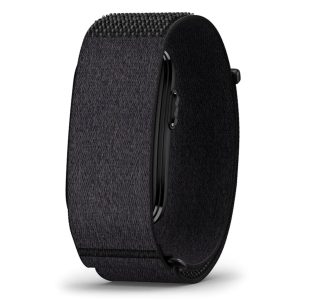
Garmin Cirqa
Up to 10 days battery
Direct sync via Fitrockr app or sync via Garmin Connect app
- Steps
- Distance
- Calories
- Activity Details
- Sleep
- Raw BBI/HRV
- Enhanced BBI/HRV
- Heart Rate
- Stress
- Body Battery
- Pulse Oxygen
- Respiration
- Actigraphy
- Skin Temperature
- GPS
- Accelerometer (restrictions apply*)
- Gyroscope
MSRP
$199.99 / €199.99
Module Size (mm):
47 x 27 x 9
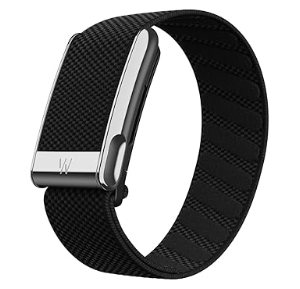
Whoop
14 days battery
Sync via Apple Health/Google Health Connect
- Steps
- Distance
- Calories
- Activity Details
- Sleep
- Raw BBI/HRV
- Enhanced BBI/HRV
- Heart Rate
- Stress
- Body Battery
- Pulse Oxygen
- Respiration
- Actigraphy
- Skin Temperature
- GPS
- Accelerometer
- Gyroscope
MSRP
$199.99/yr / €199.99/yr
Module Size (mm):
34.7 x 24 x 10.6
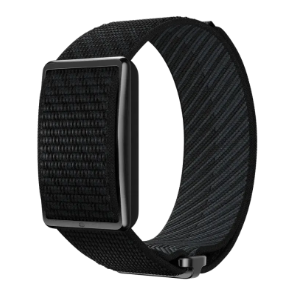
Polar Loop
Up to 8 days battery
Sync via Polar app
- Steps
- Distance
- Calories
- Activity Details
- Sleep
- Raw 24/7 BBI/HRV
- HRV (Night)
- Heart Rate
- Stress
- Body Battery
- Pulse Oxygen
- Respiration
- Actigraphy
- Skin Temperature
- GPS
- Accelerometer
- Gyroscope
MSRP
$169.99 / € 179.90
Module Size (mm):
43 x 28 x 10
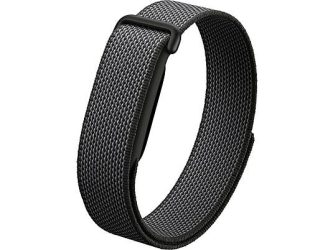
Google Fitbit Air
Up to 7 days battery
Sync via Google Health app
- Steps
- Distance
- Calories
- Activity Details
- Sleep
- Raw 24/7 BBI/HRV
- HRV (Night)
- Heart Rate
- Stress
- Body Battery
- Pulse Oxygen
- Respiration
- Actigraphy
- Skin Temperature
- GPS
- Accelerometer
- Gyroscope
MSRP
$99.99 / €99.99
Module Size (mm):
34.9 x 17 x 8.3
Listed information is indicative only, non-binding and subject to change. Prices are from July 2026 and will likely change throughout time. Confirm device specification and suitability with us prior purchasing devices.
General benefits of wearable bands
For studies, clinical trials, and healthcare programs, the wearable itself is part of the instrument — and a screen changes what it measures.
Cleaner behavioral data. Without a display, there’s no feedback loop nudging participants toward “good” numbers. Adherence and activity data reflect natural behavior, not performance for an audience of one.
Lower dropout, less friction. Screenless bands are smaller, lighter, and less obtrusive than a watch — easier to wear continuously for weeks or months without participants forgetting, removing it for social reasons, or abandoning the study altogether.
Simplified onboarding at scale. No interface to teach means less training overhead for sites, coordinators, and participants — a real advantage when you’re deploying across dozens or hundreds of subjects, especially in populations less comfortable with technology (elderly care, pediatric studies, low digital literacy cohorts).
Reduced protocol drift. A visible display invites participants to interact with the device in ways that aren’t part of the study design — checking stats, changing settings, comparing with peers. Removing the screen keeps the device doing exactly one job: capturing data.
Better fit for blinded designs. Since participants can’t see live readings, screenless bands support blinded or semi-blinded protocols where visibility into personal metrics could bias outcomes or reveal group assignment.
Cost and logistics. Simpler hardware generally means lower per-unit cost and fewer points of failure — a meaningful factor when provisioning fleets of devices for multi-site trials or long-term clinical monitoring programs.
Benefits of each specific wearable band
Garmin CIRQA — the data-completeness leader
CIRQA gives you the deepest metric set of the four, capturing nearly everything on the list — including Enhanced BBI/HRV, Body Battery, and Skin Temperature, which none of the others fully match together. It’s also the only device with a direct Fitrockr sync option that bypasses the wearable manufacturer servers and eliminates personal login/passwords for users. Trade-off: it’s the largest module (47 x 27 x 9mm) and sits at a higher price point.
WHOOP — strong physiological depth, subscription model
WHOOP matches CIRQA closely on core recovery metrics (HR, Sleep, Pulse Oxygen) and offers the longest battery life of the group at 14 days. Its compact module (34.7 x 24 x 10.6mm) is comparable in footprint to Fitbit Air. The key difference: WHOOP’s price is an annual membership fee, not a hardware purchase — meaning ongoing cost is a factor research budgets need to plan for, unlike the other three devices.
Polar Loop — the mid-range all-rounder
Polar Loop covers the essentials (Steps, Sleep, Heart Rate) at a lower price than CIRQA or WHOOP, with no subscription required. It lacks the deeper physiological layer — no Raw BBI/HRV, Stress, Body Battery, or Skin Temperature — making it better suited to general wellness tracking than clinical-grade research. Its module (43 x 28 x 10mm) is mid-sized among the group.
Google Fitbit Air — the budget, lightest-footprint option
Fitbit Air is the most affordable device by a wide margin and has the smallest, thinnest module (34.9 x 17 x 8.3mm), making it the least obtrusive to wear. It picks up more physiological signals than Polar Loop (HRV at night, Pulse Oxygen, Skin Temperature) but still falls short of CIRQA and WHOOP on Stress, Body Battery, and Raw BBI/HRV — positioning it as a cost-effective entry point rather than a research-grade instrument.
Verdict
CIRQA is the strongest fit where metric depth and native platform integration matter most (clinical studies, research); WHOOP suits use cases where the ongoing membership cost is acceptable in exchange for long battery life; Polar Loop and Fitbit Air are better suited to lighter-touch wellness or coaching programs where budget and unobtrusiveness outweigh the need for raw physiological data.